Validated self-assessments, EEG and fNIRS from any headset, continuous body metrics and
every medication or therapy, aligned on one timeline and written up as clinical-grade reports.
Objective analysis behind every diagnosis and treatment decision you make.
Mental health diagnosis still runs on self-report. Two patients can describe
the same symptoms and get two different diagnoses, and the wrong one means months
or
years of trial-and-error treatment in a $460 billion healthcare system.
6yrs
Median delay to an accurate bipolar diagnosis.
Drancourt et al., Acta Psychiatr Scand (2013)
Not just bipolar: ADHD and autism are diagnosed late, too
56%
of U.S. adults with ADHD were first diagnosed at 18 or older.
CDC, MMWR (2024)
3.9yrs
later ADHD diagnosis for females than males (23.5 vs. 19.6 years).
Skoglund et al., J Child Psychol Psychiatry (2024)
47mo
median age of autism diagnosis, though it can be identified far earlier.
CDC ADDM Network, MMWR (2025)
1 in 31 U.S. 8-year-olds has autism, and about 1 in 9 U.S. children has been
diagnosed with ADHD.CDC ADDM Network, MMWR (2025); Danielson et al., J Clin Child Adolesc
Psychol (2024)
Four channels. One objective record.
Every treatment, self-report, brain recording and body metric lands on the same
patient timeline, so you can see what changed in mind and body, and what changed it.
Medication & therapy: Everything that could change the
picture
Log treatments from traditional to experimental medications, and therapies from a morning
cold plunge to yoga or meditation. Each one marks the timeline, so the other three channels
can be read before and after it.
Medications
Traditional or experimental
Therapies
Short-term psychotherapy, all modalities, long-term psychotherapy
Alternative therapies
Ketamine, peptides, psilocybin…
Treatment windows
Historical and current
Assessments: A full clinical library
25 standard and Cogniscan-developed assessments, from 3-question
screeners to 100-question deep-dives, for children through adults. Completed at home or in
the waiting room and scored instantly.
Objective electrophysiology in the office or remotely, with online support for Muse EEG
recorders and full clinical-grade qEEG from most major EEG recording systems.
Muse headbands
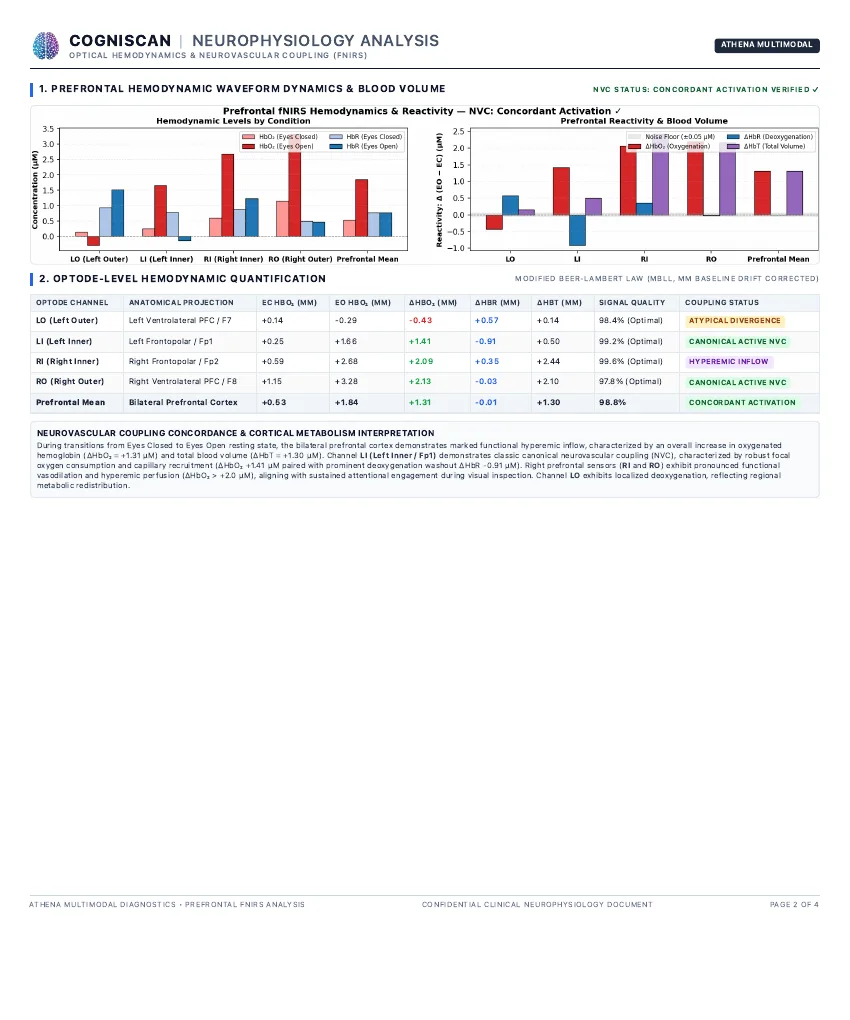
Remote, guided, with fNIRS support via Muse Athena
Research & medical grade
Supporting EDF, EDF+, BDF, BIDS, EEG & XDF formats up to 100 MB per file
Automated analysis & cleaning
Artifact cleaning, spectral qEEG, and optical fNIRS support
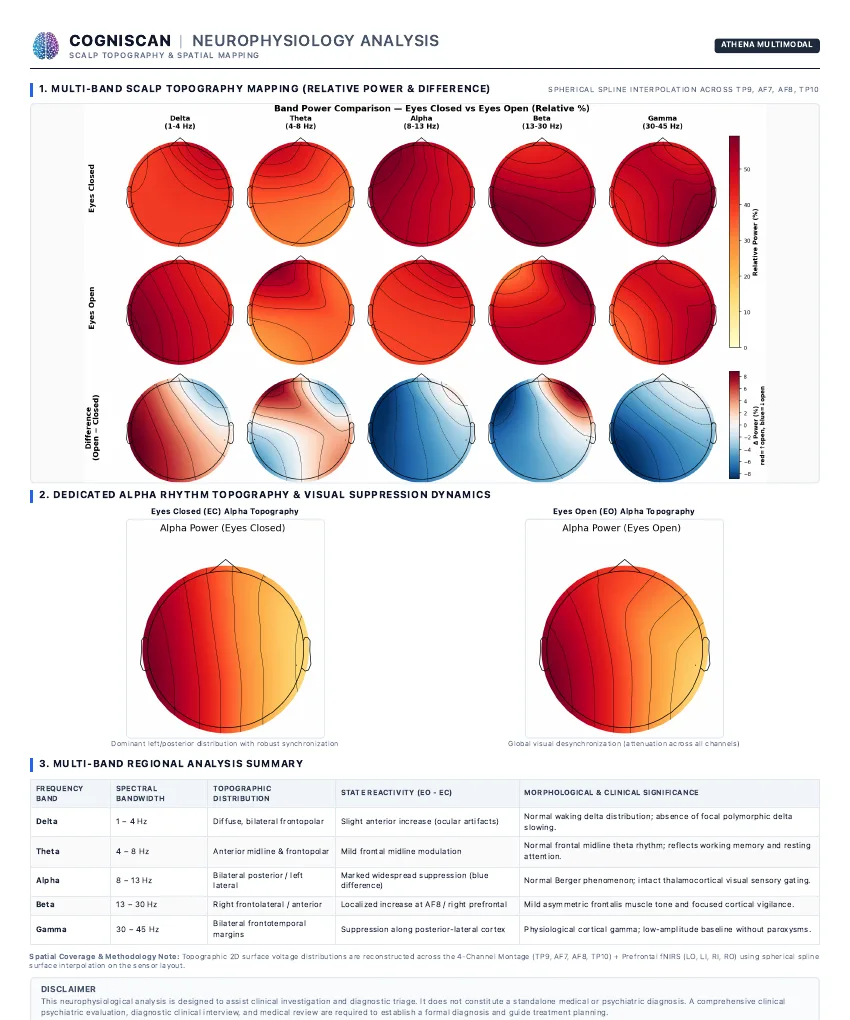
Scalp topography & montages
Automatically detects correct montage; repairs bad or missing channels
Instant turnaround
GPU-powered clusters return results in minutes, not days
Biometrics: Continuous body metrics
Passive physiological data, captured twice daily, so treatment response shows up between
visits.
Oura Ring
Sleep, HRV, readiness
WHOOP
Recovery, HRV, strain
Google Health / Fitbit
Sleep, HRV, resting HR
Withings
Body mass, blood pressure
Then ask the timeline anything. Run a Patient Trend Analysis over any date
range: choose the channels, add your own clinical question, and AI models trained with our
on-staff neurologists and clinicians report what changed and what changed alongside it.
Did the treatment work? The timeline knows.
Ask about a medication, a new therapy or anything else on the record. A Patient
Trend Analysis compares the weeks before and after, across assessments, qEEG and body metrics
that arrive twice a day, without waiting for the next follow-up.
Illustrative patient · baseline to week 12Anxiety scoreSleep recoveryqEEG sessionTreatment
Week 6 to week 12After the medication
change, the anxiety score trends down while physiological sleep recovery climbs, visible between
visits.
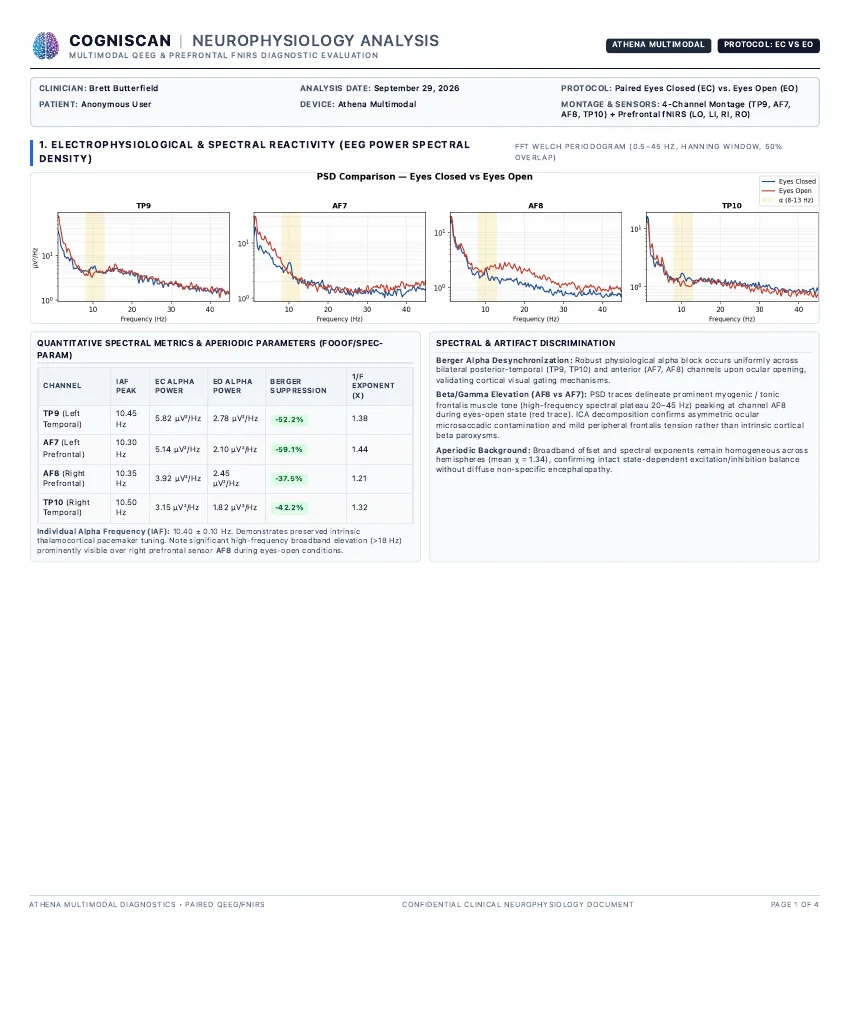
Any headset. A clinical-grade report.
From a consumer headband with fNIRS to a 20-channel clinical headset, every
eyes-closed / eyes-open session becomes a structured Neurophysiology Analysis. Two de-identified
samples:
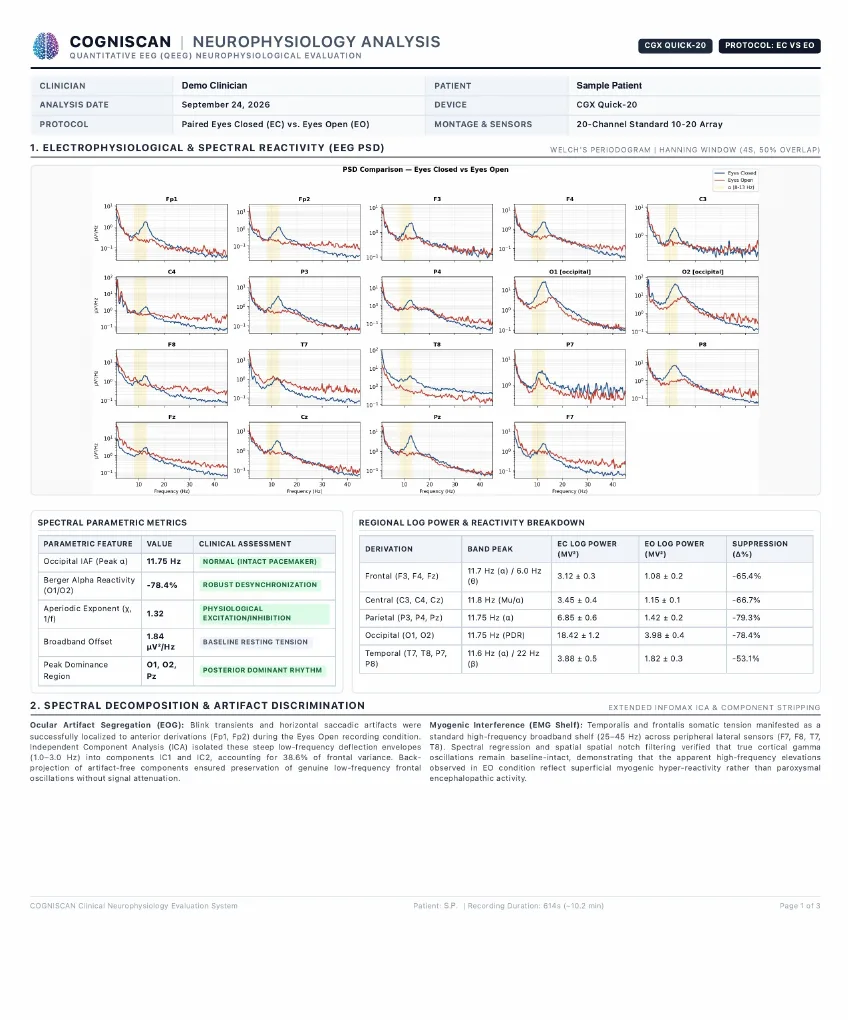
P.1Spectral qEEGPower spectra for
all 20 channels, with regional log power and alpha reactivity
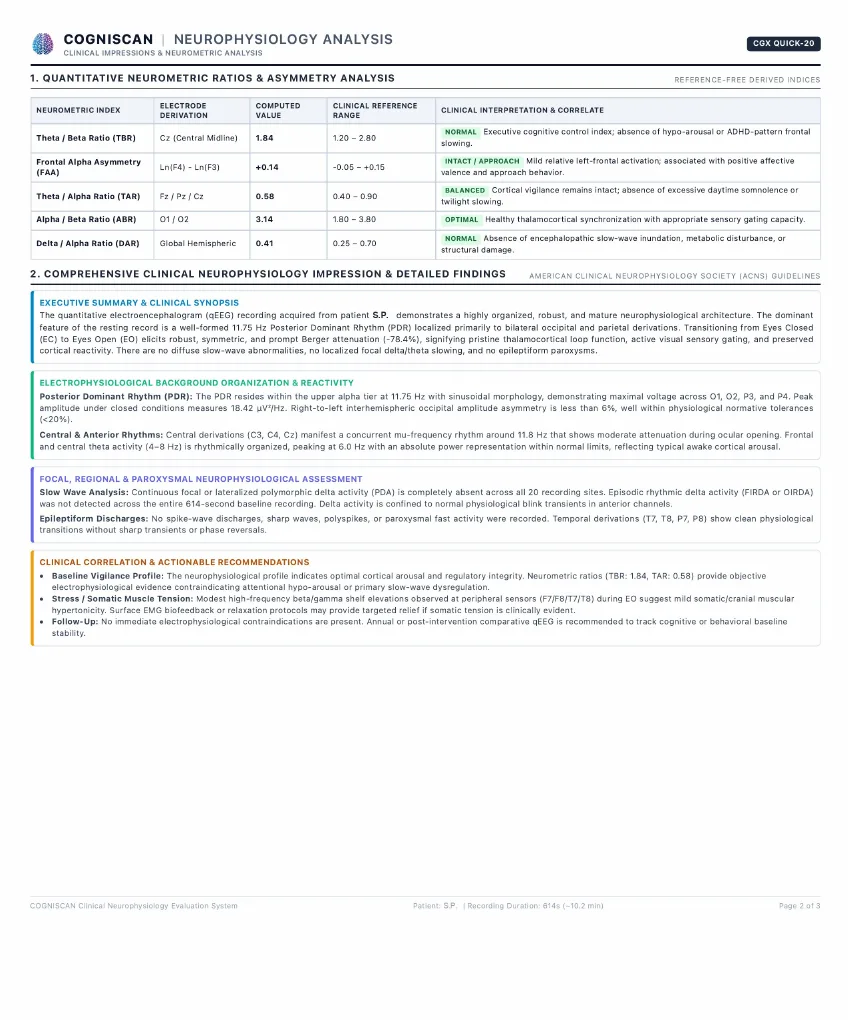
P.2Neurometrics &
impressionTheta/beta ratio, frontal alpha asymmetry and a full
clinical impression
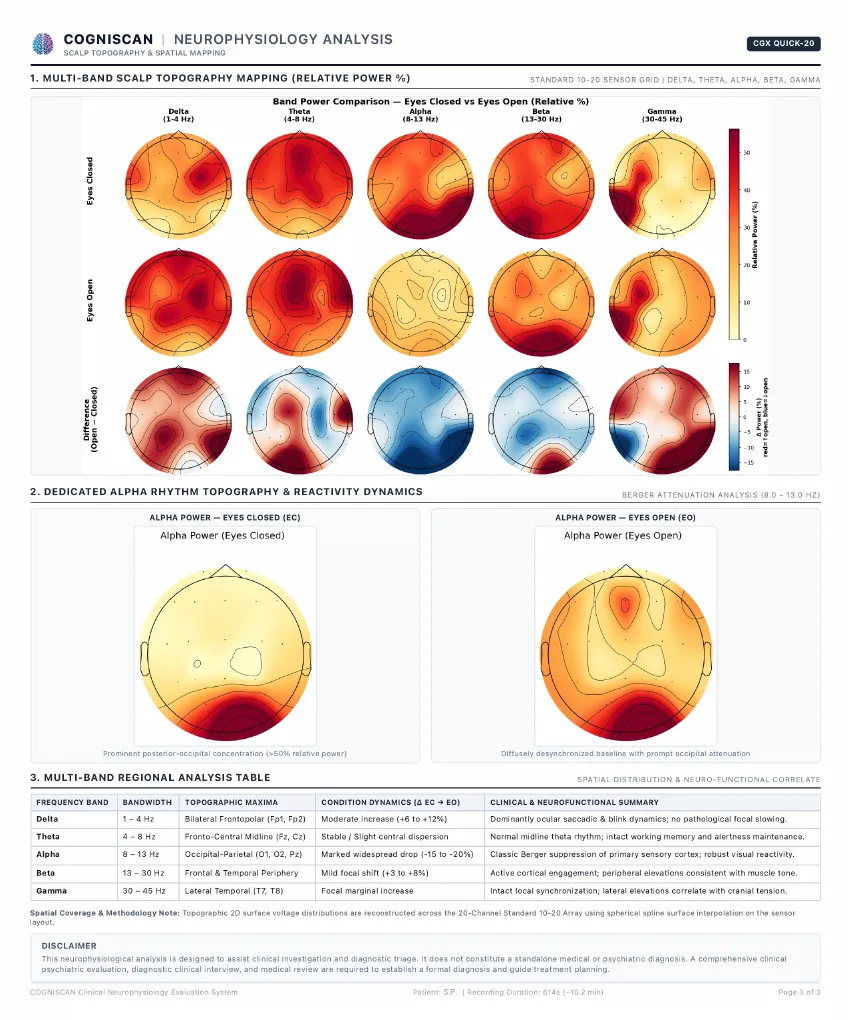
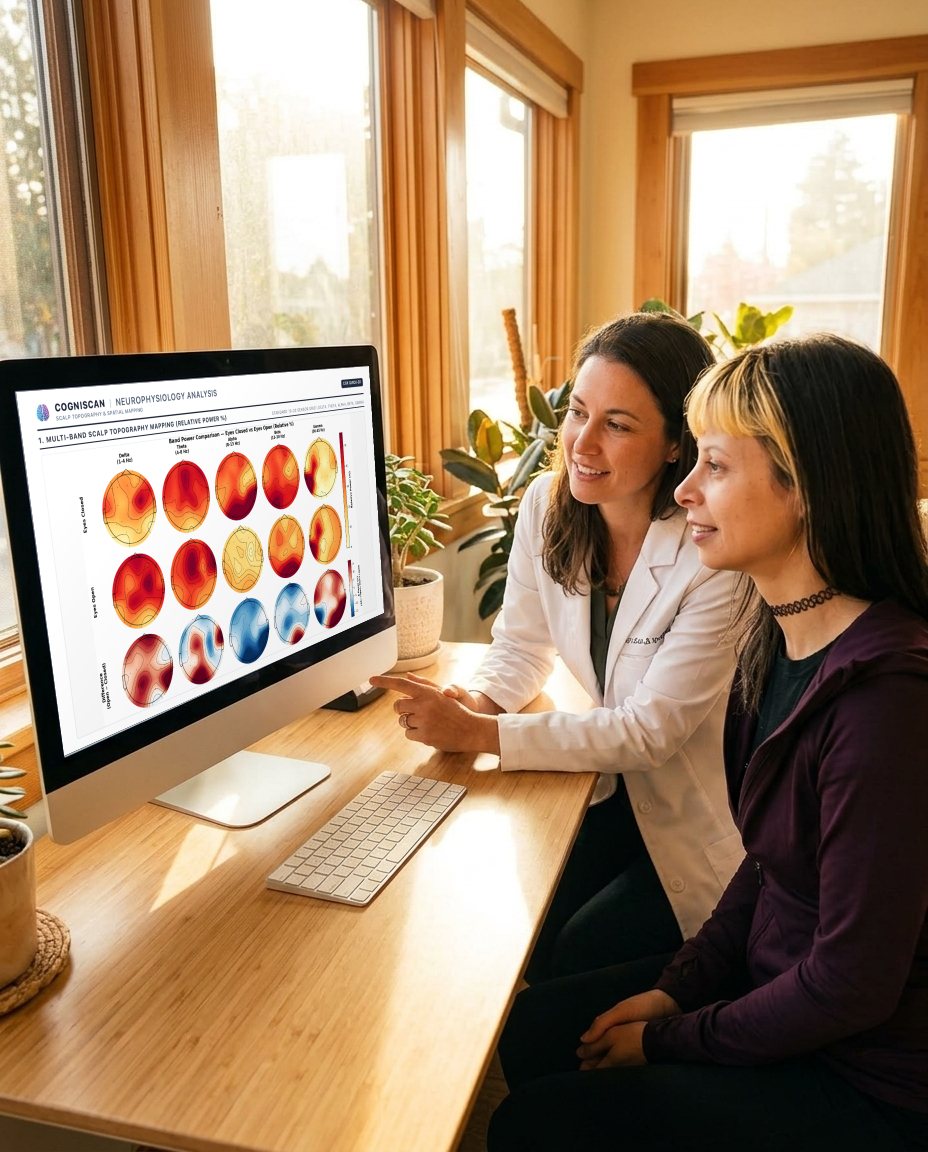
P.3Scalp topographyFive-band maps
across the 10-20 array, with dedicated alpha topography
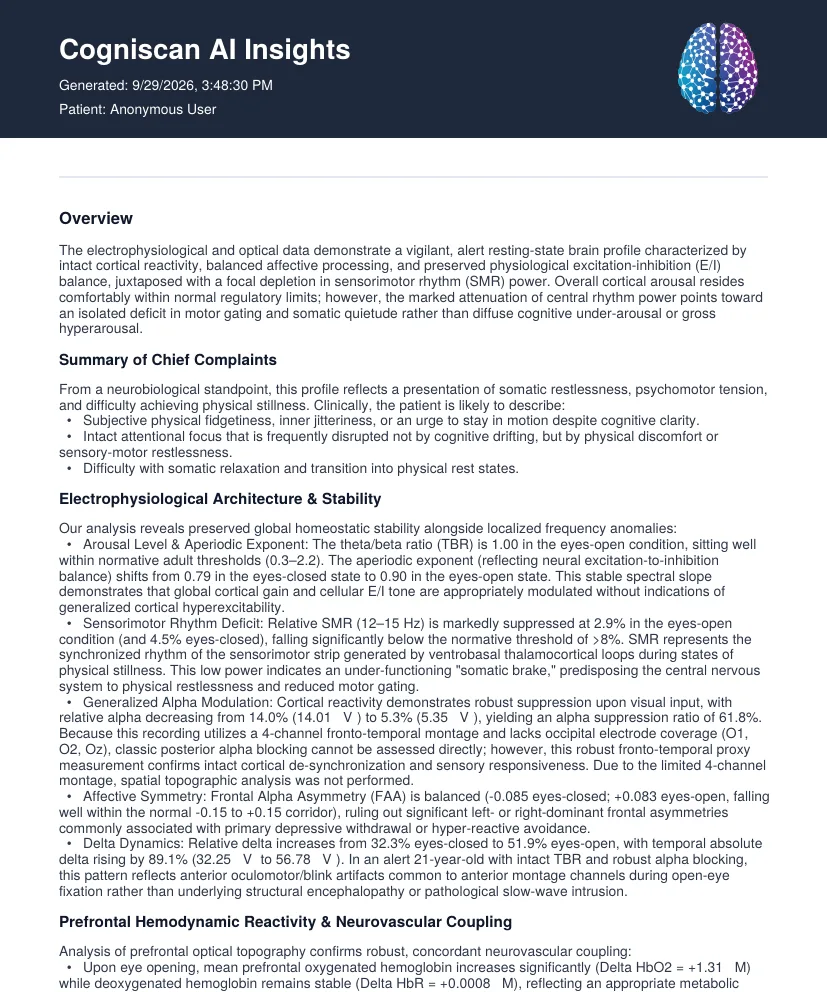
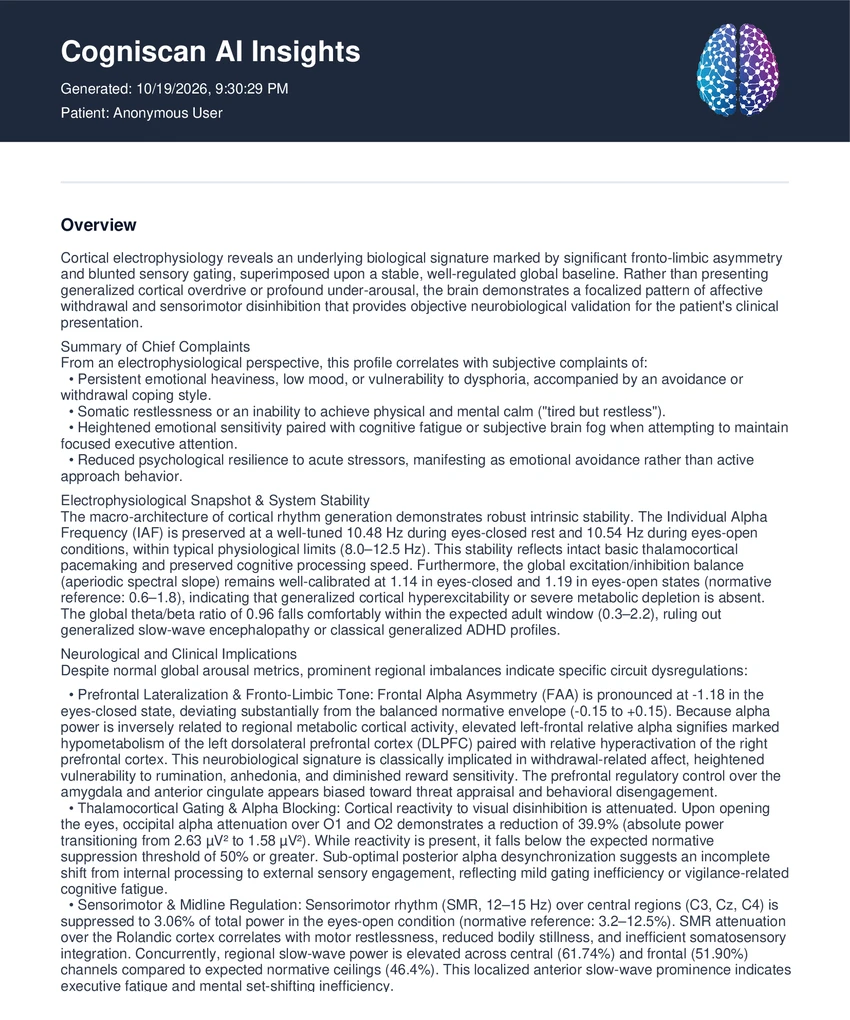
AIAI InsightsOverview, likely
presentation and differential considerations in plain language
Inside the app: a sample Muse Athena session
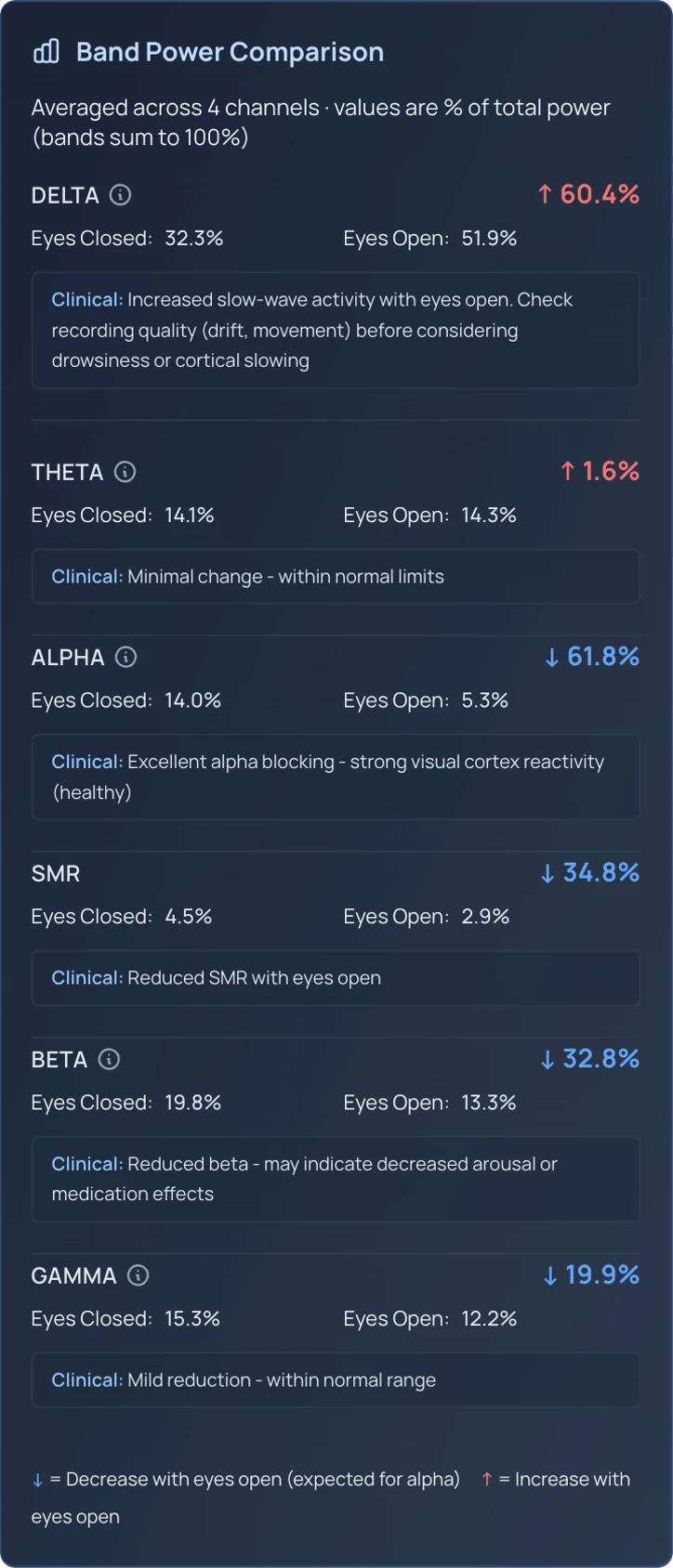
Alpha blocking
61.8%
Strong visual-cortex reactivity, within the healthy range
SMR, eyes open
(flagged)
2.9%
Below the >8% norm: an under-active “somatic brake”
Theta / beta ratio
1.00
Within adult norms (0.3–2.2)
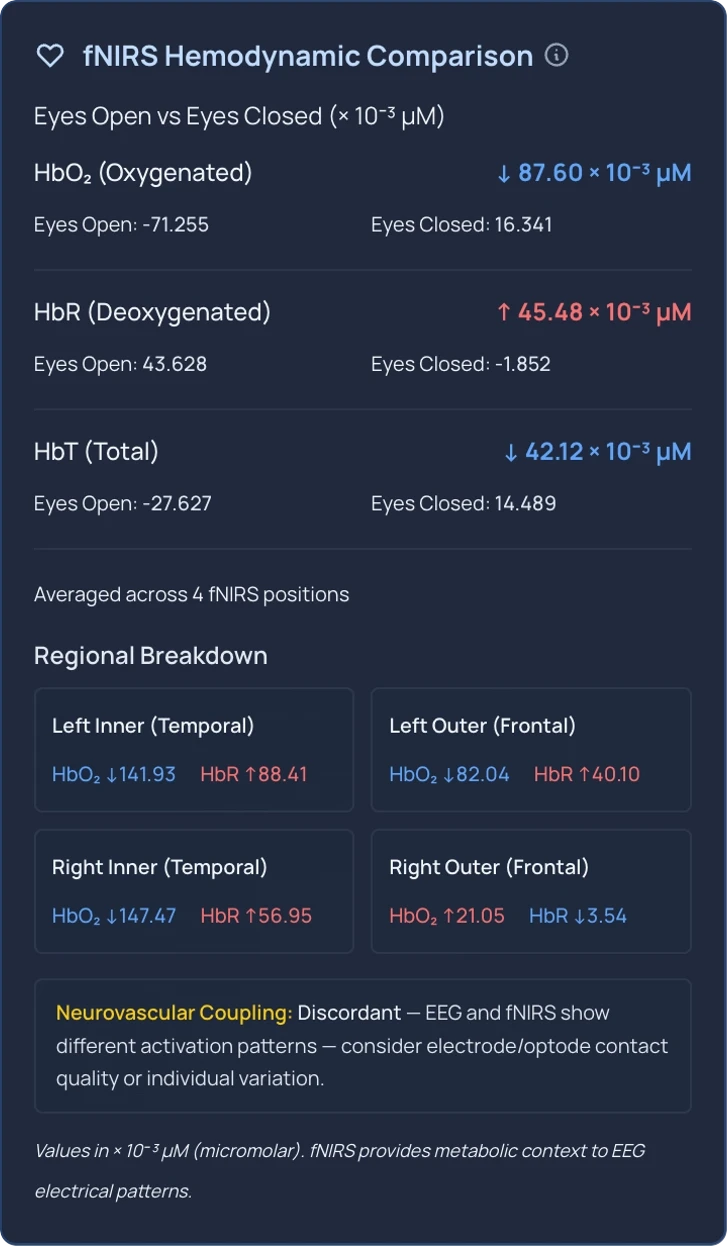
Prefrontal ΔHbO₂
+1.31µM
fNIRS confirms neurovascular coupling
“You were able to describe what I've been trying to explain to my doctors for 15 years in
15 minutes.”
1,800+
local and remote Muse Athena (EEG + fNIRS) recordings processed
1,500+
19+ channel clinical EEG recordings processed from clinicians in private beta
Initially piloted in Dr. Dean Freedlander's clinics in San Francisco &
San Jose, now utilized by dozens of clinics that had been included in our private beta. Hosted
on HIPAA-compliant Google Cloud, with a BAA for every clinical partner.
Bring objective data to every assessment.
Schedule a live clinical walkthrough with our team to onboard your practice or
research group. Remote self-assessments, wearable integration and qEEG analysis can be deployed
immediately.
A renewed invitation request has been sent to service@cogniscan.com. We
will reissue a fresh link to your email
shortly. Please make sure to complete your account setup within 24 hours of
receiving the email.
Account Already Exists
An account with the email is already registered on Cogniscan.